
If you’ve ever taught an Earth Science unit, you already know that weathering, erosion, and deposition are three concepts students constantly confuse. Even after several lessons, it’s common to hear students use the terms interchangeably or struggle to explain where one process ends and the next begins.
I’ve found that the problem isn’t that these concepts are difficult—it’s that they’re so closely connected. In nature, they happen one after another, making it challenging for students to separate each process in their minds.
Over the years, I’ve discovered a few strategies that consistently help students understand not only the differences between weathering, erosion, and deposition, but also how they work together to continually reshape Earth’s surface.
Start with the Big Picture
Before introducing vocabulary, I like students to understand the overall story.
I explain that Earth’s surface is constantly changing through a sequence of events. Rocks are first broken apart, those pieces are moved somewhere else, and eventually they settle in a new location. Once students understand that sequence, the vocabulary becomes much easier to remember.
Instead of memorizing three separate definitions, students begin thinking of weathering, erosion, and deposition as three chapters of the same story.
Focus on the Action Words
One of the easiest ways to help students distinguish these processes is by emphasizing the action taking place.
- Weathering = breaks it
- Erosion = takes it
- Deposition = drops it
Those three action words become a simple mental shortcut that students can return to whenever they’re unsure.
Throughout the unit, I reinforce those verbs during discussions, labs, and review activities until students begin using them naturally.
Use Real-World Examples
One of the reasons students enjoy this unit is because they can find examples almost everywhere.
Rather than relying only on textbook photographs, we discuss examples they’ve probably seen themselves.
For weathering, we might look at cracked sidewalks, tree roots pushing through pavement, or rocks that have broken apart over time.
When discussing erosion, students immediately recognize rivers carrying sediment, strong winds blowing sand across a beach, or waves washing away the shoreline.
Deposition becomes much easier to understand when students think about sand building up on beaches, mud settling after a flood, or deltas forming where rivers empty into larger bodies of water.
Connecting each process to familiar examples helps students realize that Earth Science isn’t something that only happens in distant places—it’s happening all around them. If your school allows it, take the students outside and have them try to identify areas of weathering, erosion, and deposition around your school.
Let Students Investigate Instead of Memorize
One of my favorite activities is giving students a series of photographs and asking them to decide which process is taking place.
Instead of telling them the answer, I ask questions like:
- What evidence do you see?
- Is the material breaking apart, moving, or settling?
- How do you know?
These conversations encourage students to justify their thinking rather than simply choosing a vocabulary word. Even when students disagree, they’re practicing scientific reasoning by using evidence to support their explanations.
Use Visual Learning
Weathering, erosion, and deposition are much easier to understand when students can actually see the processes.
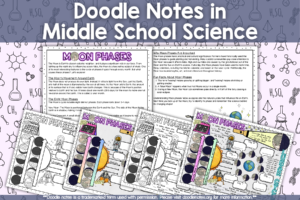
Diagrams, illustrations, photographs, and graphic organizers help students visualize what is happening at each stage. Rather than reading lengthy definitions, students can observe how a landscape changes over time and identify where each process is occurring.
Visual note-taking has been especially helpful in my classroom because students can quickly return to the diagrams when they need a reminder later in the unit.
Show How the Processes Connect

One mistake students often make is thinking weathering, erosion, and deposition are completely separate events. Throughout the unit, I emphasize that one process naturally leads to the next.
A rock may first be broken apart through weathering. Those smaller pieces are then transported by water, wind, ice, or gravity through erosion. Eventually, the moving sediment slows down and settles in a new location through deposition.
Helping students recognize this sequence makes it much easier for them to understand how landscapes change over time.
Reinforce the Concepts in Different Ways
No single activity is enough for students to master these concepts.
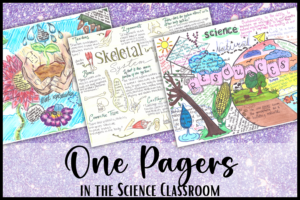
Throughout the unit, I revisit weathering, erosion, and deposition using a variety of learning activities. Students might complete visual notes one day, analyze photographs the next, create a one-pager to summarize their understanding, or review with an interactive game before an assessment.
Seeing the concepts presented in multiple formats helps students build confidence while strengthening long-term retention.
Final Thoughts
Weathering, erosion, and deposition are foundational Earth Science concepts, but they don’t have to be confusing.
When students focus on the sequence of events, connect learning to real-world examples, and repeatedly apply the concepts through discussion and visual learning, they begin to see these processes everywhere. Before long, they aren’t just memorizing definitions—they’re explaining how Earth’s surface is constantly changing around them.
That’s when the learning becomes meaningful.