
Cornell notes have been around for decades, yet they often get labeled as outdated, boring, or too rigid for today’s classrooms—especially in middle school science.
But despite new tools, flashy strategies, and digital alternatives, Cornell notes continue to work. Not because they’re trendy—but because they support how middle school students actually learn science.
When used intentionally, Cornell notes don’t limit thinking. They organize it.
Structure Is Exactly What Middle Schoolers Need
Middle school students are still developing executive functioning skills. Asking them to listen, process new information, identify key ideas, and organize it all independently is a heavy cognitive lift.
Cornell notes help by:
-
Providing a clear structure for information
-
Reducing cognitive overload
-
Teaching students how to take notes—not just what to write
This structure allows students to focus on understanding scientific concepts instead of scrambling to keep up.
Cornell Notes Support Real Science Thinking
Good science instruction isn’t about copying definitions—it’s about explaining, connecting, and applying ideas.
When used well, Cornell notes:
-
Encourage students to ask questions in the left column
-
Require summarization instead of transcription
-
Help students make sense of diagrams, processes, and data
These skills align directly with higher-order thinking, not rote memorization.
They Work With—Not Against—Engaging Instruction
One common misconception is that Cornell notes automatically make lessons boring. In reality, they support engaging instruction by giving it direction.
Cornell notes pair well with:
-
Demonstrations and labs
-
Class discussions
-
Videos and simulations
-
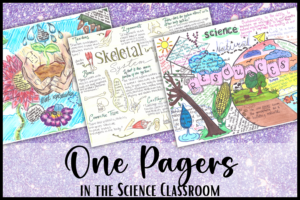
One-pagers and review activities
They give students a place to capture thinking during active learning—not after it.
Cornell Notes Build Independence Over Time
At first, Cornell notes may feel scaffolded—and that’s intentional.
Over time, students learn to:
-
Identify key ideas on their own
-
Ask better questions
-
Summarize information more effectively
These are transferable skills that benefit students far beyond science class.
Why They’re Especially Effective in Science
Science content is dense, vocabulary-heavy, and concept-driven. Cornell notes help students see relationships between ideas instead of viewing topics as disconnected facts.
That’s one reason they’re so effective for middle school science classroom management as well—students know what to do, how to do it, and why it matters.
This same balance between structure and engagement shows up across effective instruction, including review days. If review ever feels loud but unproductive, shifting toward clearer structures can make a big difference—something I share more about in how to make review days meaningful (not just loud).
The Bottom Line
Cornell notes still work because students still need structure, clarity, and guidance—especially when learning complex science concepts.
They aren’t outdated.
They’re foundational.
When used intentionally, Cornell notes don’t replace curiosity—they support it.
Grab a free Cornell Notes template to use in class. This template comes in a digital and print format.