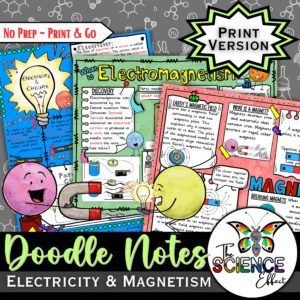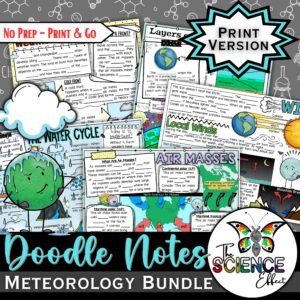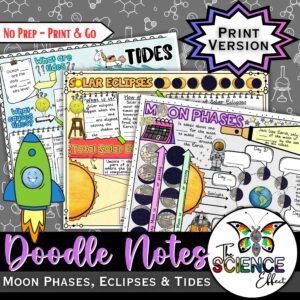
Doodle notes tend to get categorized as a “support strategy.”
And by support strategy, people usually mean for struggling students only.
But that assumption misses the point entirely. Doodle notes don’t exist to lower expectations. They exist to make thinking visible—and that benefits far more than one group of learners. Used well, doodle notes support focus, processing, and understanding for all students in science class. Yes, even the ones who already “get it.”
Why Doodle Notes Are Often Misunderstood
Doodle notes sometimes get dismissed as:
-
Artsy
-
Cute
-
Off-task
-
Something students do when they’re “done early”
Which is ironic, because copying paragraphs of notes word-for-word is somehow considered more rigorous. The issue isn’t doodle notes themselves—it’s the assumption that visuals automatically mean less thinking….They don’t.
What Doodle Notes Actually Do in Science Class
Science is abstract, layered, and vocabulary-heavy. Doodle notes help students organize that complexity visually instead of holding everything in their heads at once.
When designed intentionally, doodle notes help students:
-
Identify key ideas
-
See relationships between concepts
-
Slow down and process information
-
Retain information more effectively
They give students a framework for thinking, not just a page to fill.
Why Doodle Notes Benefit High-Achieving Students Too
Here’s the part that often gets overlooked.
Strong students don’t need more writing. They need better opportunities to:
-
Synthesize ideas
-
Make connections
-
Organize complex information
Doodle notes allow high-achieving students to:
-
Add depth through annotations and visuals
-
Extend ideas beyond the basics
-
Focus on meaning instead of transcription
Many of them actually produce higher-quality thinking when they aren’t busy rewriting information they already understand.
Visual Structure Supports Cognitive Load (For Everyone)
This isn’t about learning styles—it’s about how the brain processes information.
Visual structure:
-
Reduces cognitive overload
-
Supports working memory
-
Helps students chunk information meaningfully
Doodle notes combine visuals, language, and spatial organization in a way that makes science content more accessible without simplifying it.
I break this down more fully in the power of visual learning in science class, where I explain why visuals are essential—not optional—in science instruction.
Doodle Notes Still Require Thinking (They’re Not a Shortcut)
Let’s be clear: doodle notes aren’t just coloring pages with science words sprinkled in.
Students still need to:
-
Decide what information matters
-
Interpret diagrams and symbols
-
Connect visuals to concepts
-
Use academic language appropriately
The thinking is still there—the format just removes unnecessary barriers.
They Support Independence Over Time
Another misconception is that doodle notes create dependence.
In reality, they model how to:
-
Organize information
-
Highlight key ideas
-
Represent thinking visually
Over time, students internalize these structures and apply them more independently—exactly what scaffolding is supposed to do.
The Bottom Line
Doodle notes aren’t a strategy for “lower” students. They’re a smart instructional choice that supports understanding across ability levels. They help students focus, process, and retain complex science content—without requiring five different versions of a lesson. And honestly? Any tool that helps more students think more deeply without adding to your workload deserves a permanent place in your toolbox.
Doodle notes is a trademarked term used with permission. Please visit doodlenotes.org for more information.
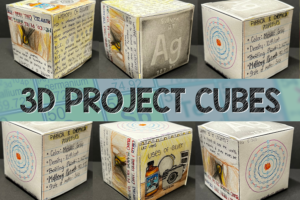
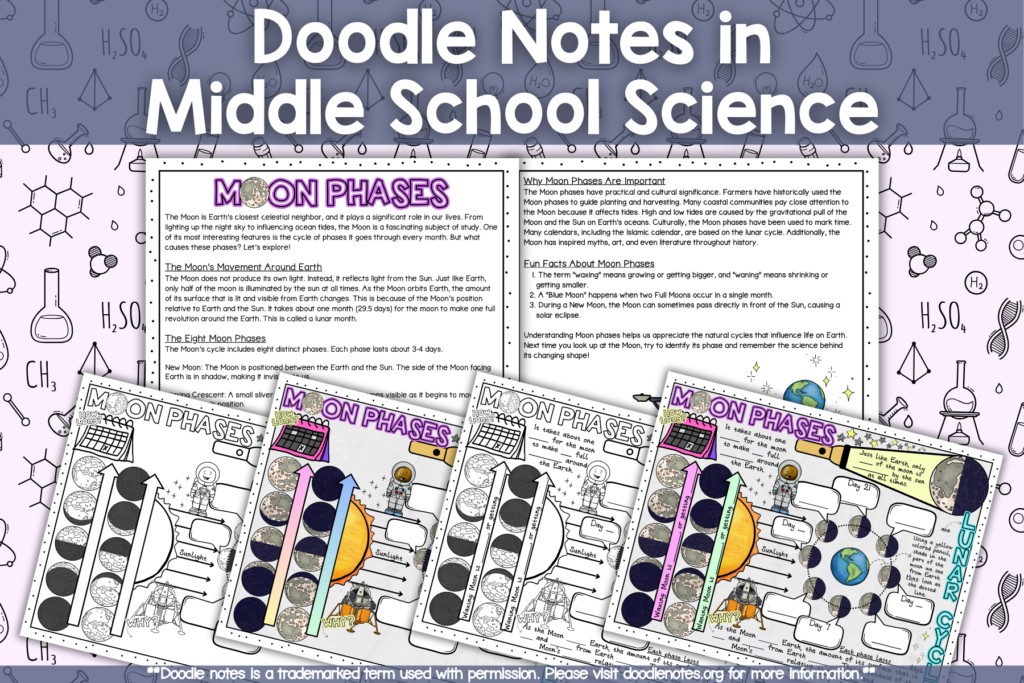
Check out some of the doodle notes I’ve created for middle school science: