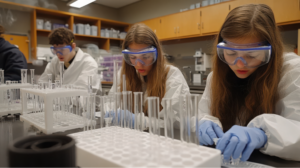

Every science teacher knows this moment. Half the class is done, a few students are staring at the ceiling, someone asks, “What do we do now?”, and meanwhile the other half of the class is still trying to figure out step one. This situation isn’t a classroom management failure. It’s a pacing problem, and it happens even in well-planned lessons.
Students move through tasks at different speeds for many reasons, including reading stamina, background knowledge, confidence, executive functioning, and language processing. A single task will almost never land perfectly for everyone at the same time, and that’s okay. The goal isn’t for everyone to finish together. The goal is for everyone to stay meaningfully engaged.
A Mistake to Avoid
A common response when students finish early is to tell them to sit quietly or check their work again. While this might buy a few minutes, it rarely sustains engagement and can actually feel like a punishment for working efficiently. Instead of giving early finishers something to do, they need something to work toward. Purpose matters.
Strategy 1 – The “Must/Should/Could” Structure
One of the simplest ways to handle pacing differences is to design tasks with built-in layers. A clear “must” sets the expectation for everyone. A “should” extends thinking or application, while a “could” offers optional challenge or reflection. This structure allows students to move forward independently without waiting for teacher direction, and it does so without adding extra worksheets or planning time.
Strategy 2 – Anchor Tasks That Actually Matter
Anchor tasks are most effective when they connect directly to the learning goal and require genuine thinking. When early finishers are asked to add to a one-pager, revise a diagram, explain a concept in their own words, or make a real-world connection, engagement stays high. Tasks that can be paused at any point also reduce pressure to rush, keeping the focus on understanding rather than completion.
Strategy 3 – Use the Gap for Small-Group Support
When early finishers are meaningfully engaged, the classroom dynamic shifts. That gap in pacing becomes an opportunity instead of a problem. It’s the moment to sit with students who need clarification, rephrase directions, catch misconceptions early, or provide targeted guidance. Early finishers aren’t being ignored—they’re helping create the space that allows deeper support for others.
Strategy 4 – Normalize Different Paces
It helps to say it out loud: people finish at different times, and that’s okay. When students expect differentiated pacing, anxiety drops and rushing decreases. Finishing early no longer feels like a status symbol or a reason to disengage. It simply becomes part of how the classroom functions.
The Big Picture
When half the class finishes early, it doesn’t mean the lesson failed. It means students are diverse thinkers working through content in different ways. With a few intentional structures in place, that awkward gap turns into a window for support, differentiation, and calm focus. Over time, the question “What do I do now?” fades away, replaced by routines that keep every student learning.